
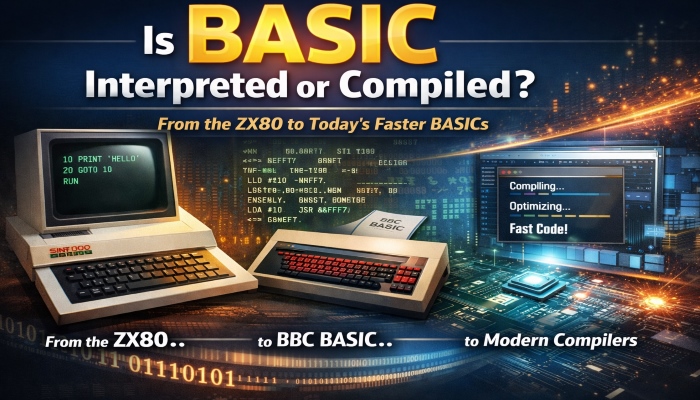
Is BASIC Interpreted or Compiled? And Can It Compete With C?
This question comes up a lot, especially from programmers who cut their teeth on early home computers:
*Is BASIC interpreted or compiled? And if it’s compiled, can it ever approach the performance of C or C++?*
The short answer is: yes, it can—but the longer answer is far more interesting.
From BASIC to Native Code
When people talk about “compiled BASIC,” they often imagine a direct leap from BASIC source code to machine code. In practice, that’s rarely how modern systems work.
It’s not uncommon—for BASIC or any language—to compile into an intermediate form first. Historically this might be bytecode, but today it could also be an abstract syntax tree or another IR (intermediate representation). From there, many systems transpile into C, LLVM IR, or another mature backend.
Why does this matter?
Because those backends are battle-tested. They encapsulate decades of optimization knowledge, and by targeting them, a BASIC compiler can automatically benefit from highly sophisticated optimization passes—without reinventing the wheel.
Generating Native Code: Several Paths
There are a few common approaches BASIC compilers have taken over the years:
Possible, but generally not recommended unless you enjoy pain.
A more common approach: translate bytecode into assembly, then feed it through an embedded assembler.
Increasingly popular, and often the most pragmatic choice.
The good news is that even a naive bytecode-to-assembly translator can produce code that runs quite well. At its simplest, this is often a near line-for-line mapping of bytecode instructions into native instructions.
That kind of output tends to hit memory a lot—but even so, it already executes far faster than an interpreter.
Where Performance Is Really Won (or Lost)
Here’s where things get interesting.
Most people think performance comes down to low-level micro-optimizations. Those matter—but they’re not where the biggest gains usually come from.
The real performance cliff is often created much earlier, by language and runtime design decisions.
Memory Access Matters
A naive translation model tends to generate excessive memory loads and stores. Simply removing redundant memory accesses can result in large performance wins.
Many BASIC compilers already perform instruction-level optimizations at the bytecode stage:
Even modest cleanup here can produce surprisingly large gains.
The Hidden Cost of “Convenience”
One of the classic examples is string handling.
In the BASIC world, string systems are often built from off-the-shelf components designed for flexibility and safety, not speed. They work—and they work well—but they can absolutely destroy performance if you’re not careful.
This isn’t a BASIC-only problem. It’s a reminder that:
Can BASIC Match C or C++?
The uncomfortable truth for some people is this:
Yes—BASIC compilers can generate code that rivals (or even beats) the output of some C compilers.
Remember:
That said, most BASIC compilers don’t aim for absolute peak performance. Their goals are often different: approachability, safety, rapid development, or portability.
But the idea that there’s some enormous, unbridgeable performance chasm between BASIC and C is largely a relic of the interpreter era.
A lot has changed since then.
Final Thoughts
The real takeaway is this:
Modern compilation techniques have blurred the old lines. Performance today is less about what language you use and more about how that language is implemented.
And that’s a far more interesting conversation than “interpreted vs compiled” ever was.


