
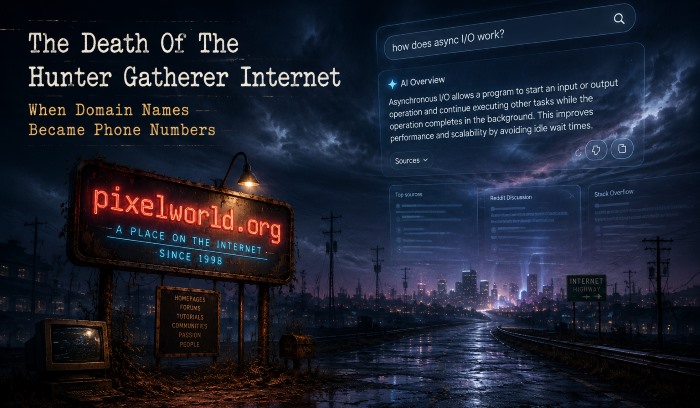
The Death Of The Hunter Gatherer Internet

May 23, 2026


Logo

The Death Of The Hunter Gatherer Internet

There was a time when searching the internet felt less like querying a database and more like wandering through a digital wilderness.

You’d type a vague phrase into a search engine and spend hours crawling through strange personal websites, forgotten forums, hobby pages, tutorials, experiments and dead ends.

The web rewarded curiosity back then.

Discovery wasn’t optimized.

It was messy, inefficient and wonderfully human.

Back then, finding information often meant finding people. You’d stumble across somebody’s obscure website about graphics programming, retro gaming, astronomy, synthesizers or some strange niche obsession they’d dedicated years to documenting. Many of these sites looked terrible. Some hadn’t been updated in years. Others were hidden three pages deep in search results behind broken layouts and blinking GIFs.

But they were alive.

The internet felt less like a product and more like a frontier.

Over time that slowly changed.

Commercialization arrived first. Then platforms consolidated communities into centralized spaces. SEO transformed writing into ranking strategy. Algorithms replaced wandering with guided pathways. The web became increasingly optimized around engagement, retention and monetization.

Search engines stopped helping users explore the web and started trying to predict exactly what users wanted as quickly as possible.

Convenience won.

The strange little corners of the internet slowly disappeared beneath waves of optimization and commercial abstraction.

Now AI search threatens to push this transformation even further.

The new direction isn’t simply about finding websites anymore. Increasingly, the goal appears to be eliminating the need to visit them altogether. Rather than returning a list of places to explore, AI systems scan, summarize and synthesize information directly into the search interface itself.

The website becomes invisible infrastructure.

To users this may feel convenient. Faster answers. Less friction. Fewer tabs. But underneath that convenience sits an uncomfortable contradiction.

What happens when the systems consuming information no longer meaningfully support the ecosystems producing it?

For decades the relationship between websites and search engines was at least somewhat reciprocal. Publishers created content. Search engines indexed it and returned visitors in exchange. Traffic became the economic fuel that justified blogs, tutorials, forums, documentation sites and independent publishing.

But AI synthesis changes that equation dramatically.

If users no longer visit the source:

  • ad revenue declines
  • discovery disappears
  • independent sites lose visibility
  • creators lose incentive to publish publicly
  • At some point people begin asking an uncomfortable question:

    Why spend weeks creating original content only for it to become fuel for systems that benefit someone else?

    This is particularly dangerous for niche and enthusiast communities. The web was built upon countless individuals sharing knowledge simply because they cared enough to document it. Technical blogs. Hobby forums. Fan sites. Tutorials. Small communities. Personal archives.

    These spaces survive because people feel connected to an audience. They feel discovered. Linked to. Referenced. Visited.

    If AI interfaces become the destination instead of the pathway, much of that incentive structure begins to collapse.

    Ironically, the more the open web becomes mined and abstracted, the more valuable closed communities may become. Newsletters, private groups, Discord servers, memberships and invite-only spaces start making more sense in a world where publicly accessible information is endlessly harvested but increasingly detached from its creator.

    The irony here is thick.

    What is a search engine without access to fresh human knowledge?

    Eventually it risks becoming little more than a history book built upon the remnants of a once living web.

    And perhaps that’s the strangest part of all.

    The internet once felt like a place people visited. Websites had identity. Domain names mattered. Communities gathered around destinations. People remembered where they found things.

    Now domain names are becoming like phone numbers.
    

    Technically important, but increasingly invisible to the people using them.

    The old hunter gatherer internet may already be gone. AI search simply makes the loss impossible to ignore anymore.
    The Caveman Web Is Gone — Can We Bring It Back?

    April 26, 2026


    Logo

    The Caveman Web Is Gone — Can We Bring It Back?

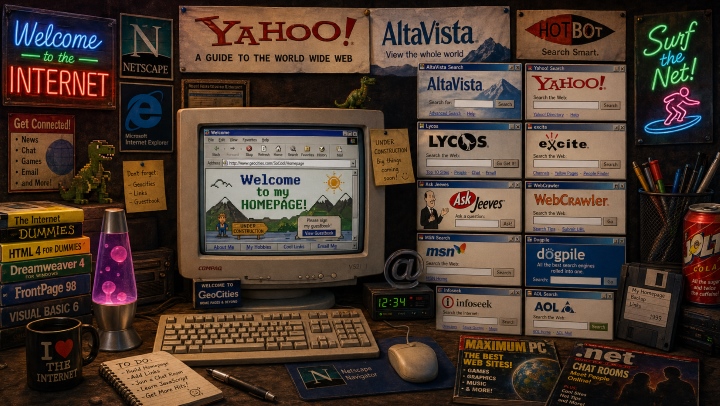
    There was a time when using the internet felt less like searching… and more like hunting.

    You didn’t know exactly what you were looking for. You just had a rough idea—and a direction. You’d throw a few keywords into a search engine, follow a trail of links, and see where it led.

    Sometimes you’d find nothing.

    Sometimes you’d strike gold.

    That was the caveman web.


    🪨 The Hunter-Gatherer Internet

    Back then, the web wasn’t about efficiency—it was about discovery.

    You’d land on a page and start exploring its edges. Almost every personal site had them:

  • Link pages
  • “Cool sites” lists (the original blogrolls)
  • Friend networks
  • Categories and subcategories
  • These were pages built by real people, pointing to other real people. One link led to another. Then another.

    You weren’t just searching.

    You were wandering.


    🔗 The Web of Links

    Links weren’t mere navigation—they were connections with meaning:

  • “This is worth your time.”
  • “These are my people.”
  • “If you liked this, you’ll like that.”
  • Sites linked freely. Communities formed organically across domains. Webrings and blogrolls helped small corners of the web find each other without any central authority.

    And somehow, no matter how tiny your site was… people still found it.

    Not through optimization.

    Not through algorithms.

    Just by following human trails.


    ⚙️ When Search Changed the Game

    Then search engines—especially Google—got really good.

    At first, it felt like magic. Type anything and get instant results. The web became searchable, accessible, fast.

    But convenience came with a subtle shift: people stopped wandering as much. Why explore when the perfect result was already ranked for you?


    📉 When Links Became Currency

    Search engines didn’t just find content—they ranked it using links as “votes.”

    That one change rewired everything:

  • Linking out started to feel risky (diluting your own authority)
  • Getting links became a competitive sport
  • Big sites consolidated power
  • Small, independent sites quietly stopped connecting outward
  • The open, freely connected web began to shrink—not technically, but culturally.


    🧱 The Rise of Gatekeepers

    Then came the platforms: social media feeds, algorithm-driven discovery.

    Now, visibility often means:

  • Post on a platform
  • Hope the algorithm favors you
  • Compete in an attention economy
  • The open web is still there—but it’s no longer the starting point for discovery. It’s where you land if you make it past the gatekeepers.


    🎯 The Death of Wandering

    Today, most people don’t explore. They:

  • Search once
  • Click a top result (or none at all)
  • And stop
  • Try broad terms like “free,” “game,” or “code.” You’ll often get ads, SEO-optimized listicles, and the same handful of dominant sites.

    Discovery has been replaced by filtering.

    Exploration has been replaced by quick answers.


    🤖 When You Don’t Even Leave the Page

    Now we’re deeper into the next phase. Search engines (and AI tools) don’t just point—they synthesize and answer directly. Zero-click results mean you rarely need to browse, let alone wander.

    The loop is closing. The caveman spirit feels further away than ever.


    🧭 So… What Can We Do?

    Here’s the hopeful twist: the solution isn’t new tech or a grand movement.

    It’s something we already did, and can do again.


    🔗 Links Still Matter

    We stopped linking freely—not because we had to, but because the incentives and culture shifted.

    Nothing technical prevents us from reversing that.

  • Add (or revive) a links page
  • Curate “Recommended reading,” “Friends of the site,” or “Other cool corners”
  • Share other independent creators generously
  • Build small, human networks again
  • Those old “Blogroll” or “Cool Sites” sections used to be everywhere. They’re rare now—but they don’t have to stay that way.


    🌱 Rebuilding the Web (One Link at a Time)

    The caveman web didn’t die because it was flawed.

    It faded because we optimized the serendipity out of it.

    But the foundation remains. Every outward link you add:

  • Creates a new path
  • Opens a door for someone else
  • Revives the chance of unexpected discovery
  • That’s how the old web grew—organically, imperfectly, humanly.


    🚀 Final Thought

    You don’t need permission to link.

    You don’t need an algorithm’s approval.

    You just need the courage to say:

     `This is worth seeing` 
    

    …and put the link on your page.

    That simple act is how the web once expanded.

    And maybe—just maybe—that’s how we bring the caveman web back, one genuine connection at a time.

    When BASIC Became a Ritual: Thoughts on Gatekeeping in Retro Coding Communities

    January 02, 2026


    Logo

    When BASIC Became a Ritual: Thoughts on Gatekeeping in Retro Coding Communities

    BASIC has a handful of holy grails. Line numbers. `GOTO` and `GOSUB`. For some, even `ON GOTO` is a step too far. Mention anything outside these markers—pointers, advanced memory access, or modern abstractions—and you risk unleashing a ritual that repeats itself endlessly in BASIC communities.

    I saw it happen recently in a Facebook BASIC group. Someone asked:

     “I am working on an interpreter for an early 1980s computer and mentioned to a friend I was coding support for memory access a little like pointers. His response was pointers have no business in BASIC! I also recall reading someone’s rant against PEEK and POKE, which were the most common approach to letting the programmer directly touch memory. The B in BASIC is Beginner’s, but hopefully we all recognize that it isn’t ONLY for beginners and supporting advanced usage has value as well.”
    

    The thread exploded. And of course, it followed the familiar pattern: someone posts code, a gatekeeper declares, “That’s not BASIC,” examples from the 1980s are invoked, definitions are argued over, and the discussion collapses into circularity. Nothing is learned, nothing is resolved, and the original idea quietly disappears. What remains is ritual—a repeated performance that reinforces who belongs and who gets to decide.


    PEEK, POKE, and Pointers: Semantics vs Symbols

    At a purely technical level, the distinction between `PEEK` / `POKE` and pointers is minimal. Both let you interact with memory. Both can be misused. Both can crash a program. The difference is clothing: one is familiar, printed in magazines, and part of the retro-coding comfort blanket; the other looks like “C,” abstracted, and too modern.

    `PEEK` and `POKE` feel safe because they’re familiar. They are a warm blanket. Pointers, by contrast, feel yucky—not because they’re dangerous or confusing, but because they look wrong. They challenge the aesthetic definition of BASIC, and that’s enough to trigger rejection.

    The paradox is clear: if BASIC truly cared about beginners, pointers would be easier to teach and safer to use. Yet familiarity often masquerades as virtue. Age and nostalgia are confused with authority.


    The Elephant and the Zebra

    I’ve been caught in these discussions more than once. For a long time, I thought if I just explained things clearly enough, minds would change. Time has helped me gain perspective. I try not to invest energy in these pursuits anymore.

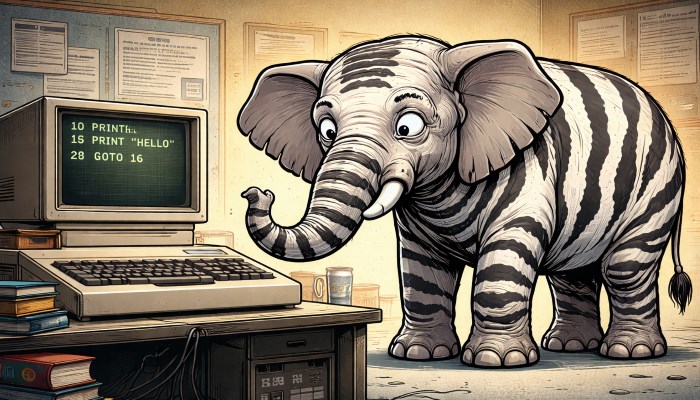
    No matter how many stripes you paint on an elephant, it’s never going to be a zebra. Arguing about what “counts” as BASIC often feels like trying to convert Coke fans to Pepsi, or asking football supporters to change clubs. The choice was made emotionally a long time ago, and no amount of technical correctness is going to undo it.

    At some point, the healthiest response isn’t disengagement from BASIC itself—it’s disengagement from the argument. Energy spent trying to win these debates is energy not spent building, teaching, or creating. These days, I focus on creation, experimentation, and helping others learn. You can’t argue someone out of an identity they didn’t argue themselves into. You can only decide where your own time is best spent.


    BASIC as a Living Language

    BASIC was never meant to be frozen in amber. It evolved constantly, even in the 70s and 80s, as programmers experimented and pushed the limits of the machines they used. Preserving that spirit doesn’t mean copying the past—it means keeping the language alive and accessible to anyone willing to learn.

    Gatekeeping may feel like stewardship, but it often does the opposite. It isolates, discourages newcomers, and shrinks the community. True preservation of BASIC’s legacy isn’t about enforcing ritual—it’s about fostering exploration and creativity, which was the heart of BASIC from the very beginning.


    Closing Thought

    Communities that obsess over purity may think they’re protecting a language, but they often end up protecting only themselves. There’s nothing wrong with nostalgia, reverence, or preference for older dialects—but when identity is enforced over experimentation, the language becomes a museum exhibit, not a tool for learning or creation.

    BASIC survives when we allow it to evolve, and when we let beginners—and even advanced users—explore it without fear of judgment. That’s the real legacy worth keeping.