
When BASIC Became a Ritual: Thoughts on Gatekeeping in Retro Coding Communities
BASIC has a handful of holy grails. Line numbers. `GOTO` and `GOSUB`. For some, even `ON GOTO` is a step too far. Mention anything outside these markers—pointers, advanced memory access, or modern abstractions—and you risk unleashing a ritual that repeats itself endlessly in BASIC communities.
I saw it happen recently in a Facebook BASIC group. Someone asked:
“I am working on an interpreter for an early 1980s computer and mentioned to a friend I was coding support for memory access a little like pointers. His response was pointers have no business in BASIC! I also recall reading someone’s rant against PEEK and POKE, which were the most common approach to letting the programmer directly touch memory. The B in BASIC is Beginner’s, but hopefully we all recognize that it isn’t ONLY for beginners and supporting advanced usage has value as well.”
The thread exploded. And of course, it followed the familiar pattern: someone posts code, a gatekeeper declares, “That’s not BASIC,” examples from the 1980s are invoked, definitions are argued over, and the discussion collapses into circularity. Nothing is learned, nothing is resolved, and the original idea quietly disappears. What remains is ritual—a repeated performance that reinforces who belongs and who gets to decide.
PEEK, POKE, and Pointers: Semantics vs Symbols
At a purely technical level, the distinction between `PEEK` / `POKE` and pointers is minimal. Both let you interact with memory. Both can be misused. Both can crash a program. The difference is clothing: one is familiar, printed in magazines, and part of the retro-coding comfort blanket; the other looks like “C,” abstracted, and too modern.
`PEEK` and `POKE` feel safe because they’re familiar. They are a warm blanket. Pointers, by contrast, feel yucky—not because they’re dangerous or confusing, but because they look wrong. They challenge the aesthetic definition of BASIC, and that’s enough to trigger rejection.
The paradox is clear: if BASIC truly cared about beginners, pointers would be easier to teach and safer to use. Yet familiarity often masquerades as virtue. Age and nostalgia are confused with authority.
The Elephant and the Zebra
I’ve been caught in these discussions more than once. For a long time, I thought if I just explained things clearly enough, minds would change. Time has helped me gain perspective. I try not to invest energy in these pursuits anymore.
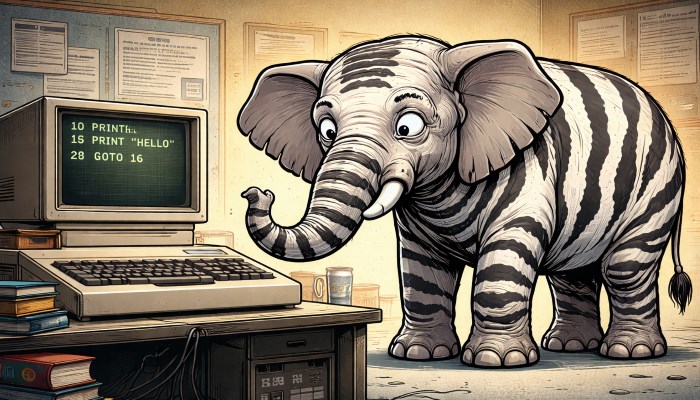
No matter how many stripes you paint on an elephant, it’s never going to be a zebra. Arguing about what “counts” as BASIC often feels like trying to convert Coke fans to Pepsi, or asking football supporters to change clubs. The choice was made emotionally a long time ago, and no amount of technical correctness is going to undo it.
At some point, the healthiest response isn’t disengagement from BASIC itself—it’s disengagement from the argument. Energy spent trying to win these debates is energy not spent building, teaching, or creating. These days, I focus on creation, experimentation, and helping others learn. You can’t argue someone out of an identity they didn’t argue themselves into. You can only decide where your own time is best spent.
BASIC as a Living Language
BASIC was never meant to be frozen in amber. It evolved constantly, even in the 70s and 80s, as programmers experimented and pushed the limits of the machines they used. Preserving that spirit doesn’t mean copying the past—it means keeping the language alive and accessible to anyone willing to learn.
Gatekeeping may feel like stewardship, but it often does the opposite. It isolates, discourages newcomers, and shrinks the community. True preservation of BASIC’s legacy isn’t about enforcing ritual—it’s about fostering exploration and creativity, which was the heart of BASIC from the very beginning.
Closing Thought
Communities that obsess over purity may think they’re protecting a language, but they often end up protecting only themselves. There’s nothing wrong with nostalgia, reverence, or preference for older dialects—but when identity is enforced over experimentation, the language becomes a museum exhibit, not a tool for learning or creation.
BASIC survives when we allow it to evolve, and when we let beginners—and even advanced users—explore it without fear of judgment. That’s the real legacy worth keeping.


