
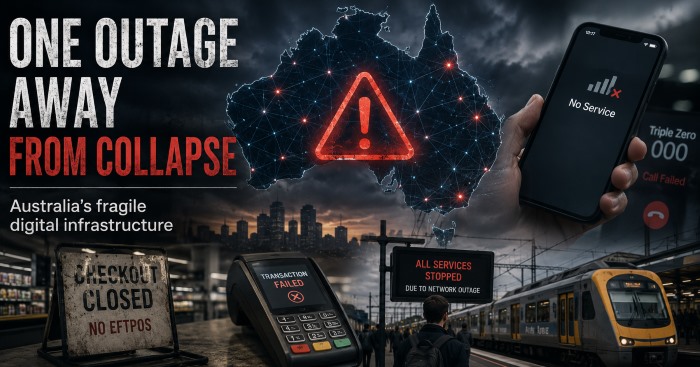
One Outage Away from Collapse: Australia’s Fragile Digital Infrastructure
Wednesday, July 8, 2026, should have been a normal day. Instead, a software defect in Telstra’s time-synchronisation nodes triggered a nationwide mobile outage that disrupted calls, data, trains, EFTPOS payments, and even some Triple Zero emergency connections. Services largely returned by mid-afternoon, but the warning remains.
This wasn’t a freak event. It was the latest chapter in a recurring story: Australia’s increasing dependence on complex, interconnected digital systems that lack sufficient redundancy. When they fail, the consequences cascade from inconvenience to genuine risk.
A Pattern of Failure
Australia’s major outages have become depressingly familiar. In November 2023, Optus suffered a nationwide collapse lasting 12–13 hours, affecting over 10 million customers and 400,000 businesses. It disrupted hospitals, banks, trains, payments, and emergency calls — with more than 2,000 people reportedly unable to reach Triple Zero. Optus was later fined $12 million.
Further Optus issues in 2025 again impacted emergency services, with tragic reports linked to failed calls. Vodafone faced intermittent nationwide problems as recently as June 2026. Banking services are routinely affected too: Commonwealth Bank has experienced multiple outages impacting apps, online banking, and ATMs. NAB and others report similar disruptions.
Regional Australia fares worse. Promised 99.9% uptime for internet services often feels aspirational. Undersea cable cuts, such as those affecting Tasmania in 2022, showed how quickly connectivity — and with it payments and services — can vanish.
Power outages compound the problem. As one shopper experienced at Coles, when the lights go out, so do the POS terminals. With minimal offline modes or manual backups, lanes close and customers leave empty-handed. Large supermarkets like Coles and Woolworths appear to have little tolerance for degraded operations.
The Human Cost and Cashless Risks
The July 2026 Telstra outage extended beyond annoyance. Some Triple Zero calls failed, prompting welfare checks on hundreds of cases. A South Australian senator claimed an elderly resident died after being unable to connect during an emergency, though SA Police stated they were not aware of any such linked death. The risk to vulnerable people is clear.
This vulnerability is amplified by our rapid shift toward a cashless society. During the outage, EFTPOS terminals failed across retailers. Many businesses struggled, and customers reached for emergency cash that fewer and fewer people now carry.
Why Redundancy Remains Elusive
The root issues are structural. Providers optimise for efficiency and cost. Building true redundancy adds expense. Regulators investigate, but systemic change is slow. Single points of failure abound, and regional areas often bear the heaviest burden.
Time for Real Resilience
Practical steps forward include mandating offline modes for critical systems, enforcing better redundancy for telcos and retailers, investing in regional infrastructure, and treating resilience as a national priority rather than an afterthought.
The Telstra outage of July 2026, like those before it, was predictable in hindsight. Until Australia demands — and enforces — genuine resilience across telecom, retail, banking, and emergency services, the next disruption is only a matter of time.


