
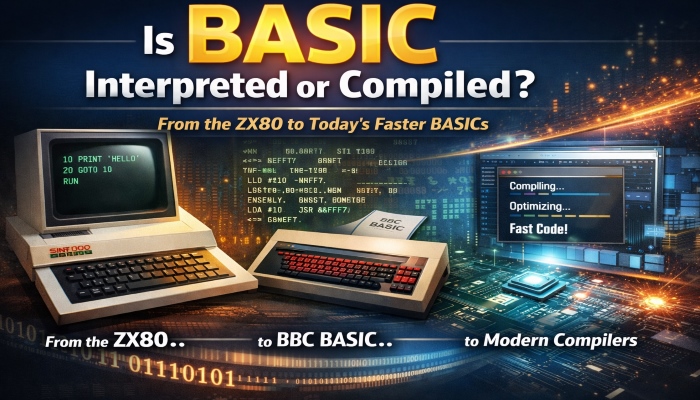
Is BASIC Interpreted or Compiled? And Can It Compete With C?

January 14, 2026


Logo

Is BASIC Interpreted or Compiled? And Can It Compete With C?

This question comes up a lot, especially from programmers who cut their teeth on early home computers:

 *Is BASIC interpreted or compiled? And if it’s compiled, can it ever approach the performance of C or C++?*

The short answer is: yes, it can—but the longer answer is far more interesting.


From BASIC to Native Code

When people talk about “compiled BASIC,” they often imagine a direct leap from BASIC source code to machine code. In practice, that’s rarely how modern systems work.

It’s not uncommon—for BASIC or any language—to compile into an intermediate form first. Historically this might be bytecode, but today it could also be an abstract syntax tree or another IR (intermediate representation). From there, many systems transpile into C, LLVM IR, or another mature backend.

Why does this matter?

Because those backends are battle-tested. They encapsulate decades of optimization knowledge, and by targeting them, a BASIC compiler can automatically benefit from highly sophisticated optimization passes—without reinventing the wheel.


Generating Native Code: Several Paths

There are a few common approaches BASIC compilers have taken over the years:

  • Direct machine code generation
  • Possible, but generally not recommended unless you enjoy pain.

  • Assembly generation
  • A more common approach: translate bytecode into assembly, then feed it through an embedded assembler.

  • C or modern IR backends
  • Increasingly popular, and often the most pragmatic choice.

    The good news is that even a naive bytecode-to-assembly translator can produce code that runs quite well. At its simplest, this is often a near line-for-line mapping of bytecode instructions into native instructions.

    That kind of output tends to hit memory a lot—but even so, it already executes far faster than an interpreter.


    Where Performance Is Really Won (or Lost)

    Here’s where things get interesting.

    Most people think performance comes down to low-level micro-optimizations. Those matter—but they’re not where the biggest gains usually come from.

    The real performance cliff is often created much earlier, by language and runtime design decisions.

    Memory Access Matters

    A naive translation model tends to generate excessive memory loads and stores. Simply removing redundant memory accesses can result in large performance wins.

    Many BASIC compilers already perform instruction-level optimizations at the bytecode stage:

  • Removing redundant loads and stores
  • Eliminating dead code
  • Collapsing simple instruction sequences
  • Even modest cleanup here can produce surprisingly large gains.


    The Hidden Cost of “Convenience”

    One of the classic examples is string handling.

    In the BASIC world, string systems are often built from off-the-shelf components designed for flexibility and safety, not speed. They work—and they work well—but they can absolutely destroy performance if you’re not careful.

    This isn’t a BASIC-only problem. It’s a reminder that:

  • Performance isn’t just about the compiler.
  • It’s about how the language chooses to represent and manage data.

  • Can BASIC Match C or C++?

    The uncomfortable truth for some people is this:

    Yes—BASIC compilers can generate code that rivals (or even beats) the output of some C compilers.

    Remember:

  • Not all C compilers are equal
  • Not all C code is well-written
  • And not all optimizers are created equal
  • That said, most BASIC compilers don’t aim for absolute peak performance. Their goals are often different: approachability, safety, rapid development, or portability.

    But the idea that there’s some enormous, unbridgeable performance chasm between BASIC and C is largely a relic of the interpreter era.

    A lot has changed since then.


    Final Thoughts

    The real takeaway is this:

  • BASIC doesn’t have to be slow
  • Compilation strategies matter
  • Runtime design matters even more
  • Modern compilation techniques have blurred the old lines. Performance today is less about what language you use and more about how that language is implemented.

    And that’s a far more interesting conversation than “interpreted vs compiled” ever was.

    Is XOR Decryption in PlayBASIC as Fast as Assembly?

    July 07, 2025


    Logo

    🔍 Is XOR Decryption in PlayBASIC as Fast as Assembly?

    Every now and then, a forum question pops up that really catches my attention — and this one did just that. A PlayBASIC user recently asked:

    > "Is using XOR decryption when loading media from memory in PlayBASIC as fast as doing it in assembly?"

    At first, I was a little puzzled. Why? Because the function in question is written in assembly — it's already doing exactly what the user thought might be a separate optimization path. So, let's unpack what's really going on behind the scenes when you XOR encrypted media in memory using PlayBASIC.


    🔐 XOR Media Loading: A Quick Recap

    Years ago, PlayBASIC added support for loading media directly from memory. Earlier versions relied on external packer tools to encrypt and wrap media, but these days, you can load and decode encrypted content entirely from within your program.

    The basic workflow is:

    1. 1. Load your file into memory.
    2. 2. Call the `XORMemory` function with a key.
    3. 3. The content is decrypted and ready to use.

    You can use any XOR key you like. While XOR encryption is relatively simple and easily reversible, it’s still useful for basic protection against casual asset ripping.


    🧠 What Happens Internally?

    When you call `XORMemory`, PlayBASIC doesn’t interpret the data — it pushes the work down to the engine’s internal rendering system. Specifically, it uses the XOR ink mode inside the `Box` drawing function.

    This function writes color data onto a surface by XOR’ing it with the existing pixels. Here’s what makes it cool: that surface isn’t necessarily a visible screen — it's just treated as raw memory.

    To decrypt, the engine:

  • Creates a temporary 32-bit image buffer (must be 32-bit to handle raw data correctly).
  • Loads the encrypted file data into that buffer.
  • Applies the XOR key using the `Box` command in XOR mode.
  • Copies the result back to memory.
  • That’s it.


    💥 But Is It Fast?

    Yes. Very fast — because under the hood, this process is powered by raw MMX assembly.

    When the engine detects MMX support, it uses MMX instructions to process 64 bits (two 32-bit pixels) at a time:

  • Data is loaded into MMX registers.
  • XOR is performed at the hardware level.
  • Results are written back immediately.
  • Here’s the inner loop in plain terms:

  • Load two pixels from memory.
  • Load XOR key into a register.
  • XOR them.
  • Write them back.
  • Repeat in a tight loop.
  • We’re talking near cycle-per-pixel speeds here — hardware-level performance. If MMX isn't available, it gracefully falls back to optimized C code. Either way, you're getting a performance-optimized routine.


    🕰 Legacy Notes

    Older machines or systems using 16-bit display modes may encounter issues unless you force a 32-bit surface. That’s why the engine explicitly creates a 32-bit buffer in the decoding routine — it ensures consistent behavior across different environments.

    Also worth noting: drawing directly to the screen (especially in older systems where the screen buffer lives in VRAM) would be very slow due to the read/write overhead. But modern systems (e.g., Windows 10/11) emulate these surfaces in system memory, allowing direct blending without penalty.


    ✅ Final Thoughts

    So, to answer the original question:

    Yes — XOR decryption in PlayBASIC is as fast as it can be. It’s literally done in machine code.

    This is just one example of how PlayBASIC leans on low-level optimizations to make higher-level features accessible and fast. You get the convenience of a BASIC command, but the performance of assembly behind the scenes.


    Got more technical questions?

    Join the conversation on the forums, or check out the help files for more info about ink modes, memory banks, and low-level drawing operations.


    Tags:

    `#PlayBASIC` `#GameDev` `#Encryption` `#Assembly` `#MMX` `#XOR` `#RetroCoding` `#Performance`