
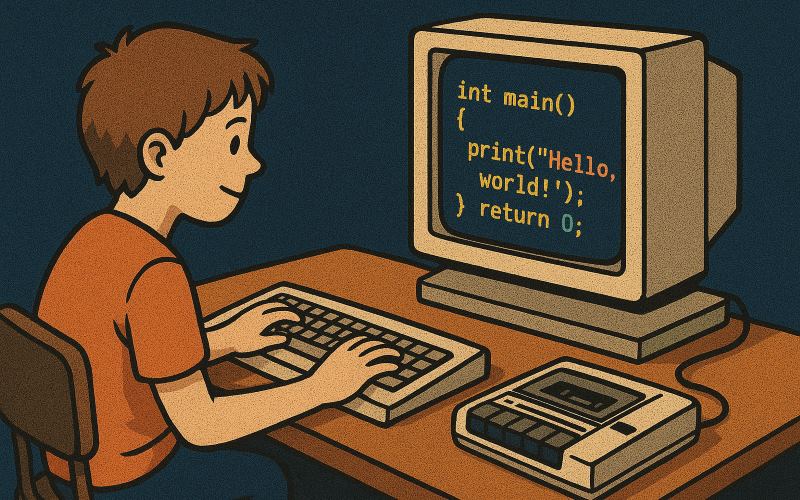
Remember when a whole generation of kids kick-started the games industry by digging through 8-bit hardware manuals

November 18, 2025


Logo

Remember when a whole generation of kids kick-started the games industry by digging through 8-bit hardware manuals?

I do.

Back then, we made things simply because coding was how you made things.

Nobody cared how it looked on a CV. Nobody waited for permission, or worried about “best practices” or “the perfect engine.” We experimented. We shared ideas. We read magazines (ask your parents what a magazine is!). We broke things and fixed them. We layered idea upon idea until the impossible suddenly wasn’t.

People called it talent.

It wasn’t.

It was curiosity, consistency, and a methodical approach to building skills.

Today? We’re drowning in information. Thousands of tutorials, hundreds of languages, endless opinions echoing in your head: Do this. Don’t do that. You must learn this first. No, learn that.

It’s no wonder beginners freeze before they even start.

But here’s the truth:

If you want to learn to code, pick a language — any language — and give it a shot.

The specific language matters far less than people claim.

Once you understand the basics in one, those skills transfer. Moving to another becomes easier. Concepts repeat. Patterns reappear. You build momentum.

Start small.

Be proud of the little victories.

And if your first attempt doesn’t stick? That’s normal. Try again later. You’ll be surprised how much your brain held onto.

Where you start isn’t where you’ll finish — and that’s the whole point.

Just keep going!

#LearnToCode #CodingJourney #ProgrammingMotivation #GameDevBeginners #CodeNewbies #StartCoding #KeepCoding #ProgrammingLife #RetroCoding #OldSchoolComputing #IndieDevLife #GameDevCommunity #SoftwareDevelopment #DeveloperMindset #ProgrammingBasics #CodingTips #CodeEveryday #STEMEducation #TechInspiration #GamedevHistory #8bitComputing #CreativeCoding #BuildInPublic #FutureDevelopers

Is XOR Decryption in PlayBASIC as Fast as Assembly?

July 07, 2025


Logo

🔍 Is XOR Decryption in PlayBASIC as Fast as Assembly?

Every now and then, a forum question pops up that really catches my attention — and this one did just that. A PlayBASIC user recently asked:

> "Is using XOR decryption when loading media from memory in PlayBASIC as fast as doing it in assembly?"

At first, I was a little puzzled. Why? Because the function in question is written in assembly — it's already doing exactly what the user thought might be a separate optimization path. So, let's unpack what's really going on behind the scenes when you XOR encrypted media in memory using PlayBASIC.


🔐 XOR Media Loading: A Quick Recap

Years ago, PlayBASIC added support for loading media directly from memory. Earlier versions relied on external packer tools to encrypt and wrap media, but these days, you can load and decode encrypted content entirely from within your program.

The basic workflow is:

  1. 1. Load your file into memory.
  2. 2. Call the `XORMemory` function with a key.
  3. 3. The content is decrypted and ready to use.

You can use any XOR key you like. While XOR encryption is relatively simple and easily reversible, it’s still useful for basic protection against casual asset ripping.


🧠 What Happens Internally?

When you call `XORMemory`, PlayBASIC doesn’t interpret the data — it pushes the work down to the engine’s internal rendering system. Specifically, it uses the XOR ink mode inside the `Box` drawing function.

This function writes color data onto a surface by XOR’ing it with the existing pixels. Here’s what makes it cool: that surface isn’t necessarily a visible screen — it's just treated as raw memory.

To decrypt, the engine:

  • Creates a temporary 32-bit image buffer (must be 32-bit to handle raw data correctly).
  • Loads the encrypted file data into that buffer.
  • Applies the XOR key using the `Box` command in XOR mode.
  • Copies the result back to memory.
  • That’s it.


    💥 But Is It Fast?

    Yes. Very fast — because under the hood, this process is powered by raw MMX assembly.

    When the engine detects MMX support, it uses MMX instructions to process 64 bits (two 32-bit pixels) at a time:

  • Data is loaded into MMX registers.
  • XOR is performed at the hardware level.
  • Results are written back immediately.
  • Here’s the inner loop in plain terms:

  • Load two pixels from memory.
  • Load XOR key into a register.
  • XOR them.
  • Write them back.
  • Repeat in a tight loop.
  • We’re talking near cycle-per-pixel speeds here — hardware-level performance. If MMX isn't available, it gracefully falls back to optimized C code. Either way, you're getting a performance-optimized routine.


    🕰 Legacy Notes

    Older machines or systems using 16-bit display modes may encounter issues unless you force a 32-bit surface. That’s why the engine explicitly creates a 32-bit buffer in the decoding routine — it ensures consistent behavior across different environments.

    Also worth noting: drawing directly to the screen (especially in older systems where the screen buffer lives in VRAM) would be very slow due to the read/write overhead. But modern systems (e.g., Windows 10/11) emulate these surfaces in system memory, allowing direct blending without penalty.


    ✅ Final Thoughts

    So, to answer the original question:

    Yes — XOR decryption in PlayBASIC is as fast as it can be. It’s literally done in machine code.

    This is just one example of how PlayBASIC leans on low-level optimizations to make higher-level features accessible and fast. You get the convenience of a BASIC command, but the performance of assembly behind the scenes.


    Got more technical questions?

    Join the conversation on the forums, or check out the help files for more info about ink modes, memory banks, and low-level drawing operations.


    Tags:

    `#PlayBASIC` `#GameDev` `#Encryption` `#Assembly` `#MMX` `#XOR` `#RetroCoding` `#Performance`

    Game Dev and the Rockstar Illusion

    June 23, 2025


    Logo

    🎮 Game Dev and the Rockstar Illusion

    At some point, many aspiring game developers ask the same question:

    "Should I pursue game development as a career?"

    It’s a fair question — and one I’ve heard dozens of times over the years. My usual answer goes something like this:

     Game development, for many of us, is the modern-day rockstar path. The huge potential upsides suspend people’s disbelief. Sheer optimism draws people into making life-changing career decisions on flimsy grounds.
    

    And I still stand by that.


    The Seductive Myth

    There’s a dream attached to game development that’s hard to shake.

    Make a hit indie game. Build a loyal community. Quit your day job. Maybe even go viral and rake in millions. We've all seen it happen. Stardew Valley. Undertale. Minecraft. Those stories are real — and they’re incredibly inspiring.

    But here’s the thing: they’re not the rule. They’re the outliers. The exceptions. The lottery wins.


    The Reality Check

    Making software is difficult.

    Making successful software? Even harder.

    Now try making a successful game in one of the most oversaturated creative markets on the planet.

    It’s not just about writing code or drawing sprites. It’s game design, storytelling, marketing, community building, testing, patching, supporting — usually with limited time, resources, or income. Even with passion and dedication, a great game can vanish in the noise of the marketplace.

    This isn’t meant to scare you off — but it is meant to snap the illusion. Because game development isn’t a shortcut to fame or fortune. It’s work. Deep, complex, and often unpredictable work.


    Why Do It Then?

    Because you love it. Because it fascinates you. Because making something interactive — something playable — is uniquely satisfying.

    For many of us, that’s reason enough. But the key is understanding that passion alone isn’t a business model. The most sustainable developers I know treat game dev like a long game. They build skills slowly. They wear many hats. They take breaks. They fail, adapt, and keep going.


    Career vs. Calling

    You can make a career in game development — but go in with your eyes open.

    Ask yourself:

  • Do I enjoy the process, not just the outcome?
  • Am I okay with uncertainty and iteration?
  • Can I build skills that work outside games too?
  • Am I doing this because I love it — or because I want to “make it”?
  • If you’re honest with yourself about those answers, you’ll save a lot of time and heartache.


    Final Thought

    Chasing the dream isn’t wrong — just don’t buy into the fantasy wholesale.

    Game development is an incredible field, but it’s not a guaranteed golden ticket.

    Build your foundation. Grow your skills. Be curious, be resilient — and enjoy the ride.